

Phish of the Week
November 9, 2026
Phish of the Week 09th of November

# Phish of the Week
# Phishing
End of Year Bonus Payment

Mette Luntama
Phish of the Week: CEO Impersonation with Fake End-of-Year Bonus Form
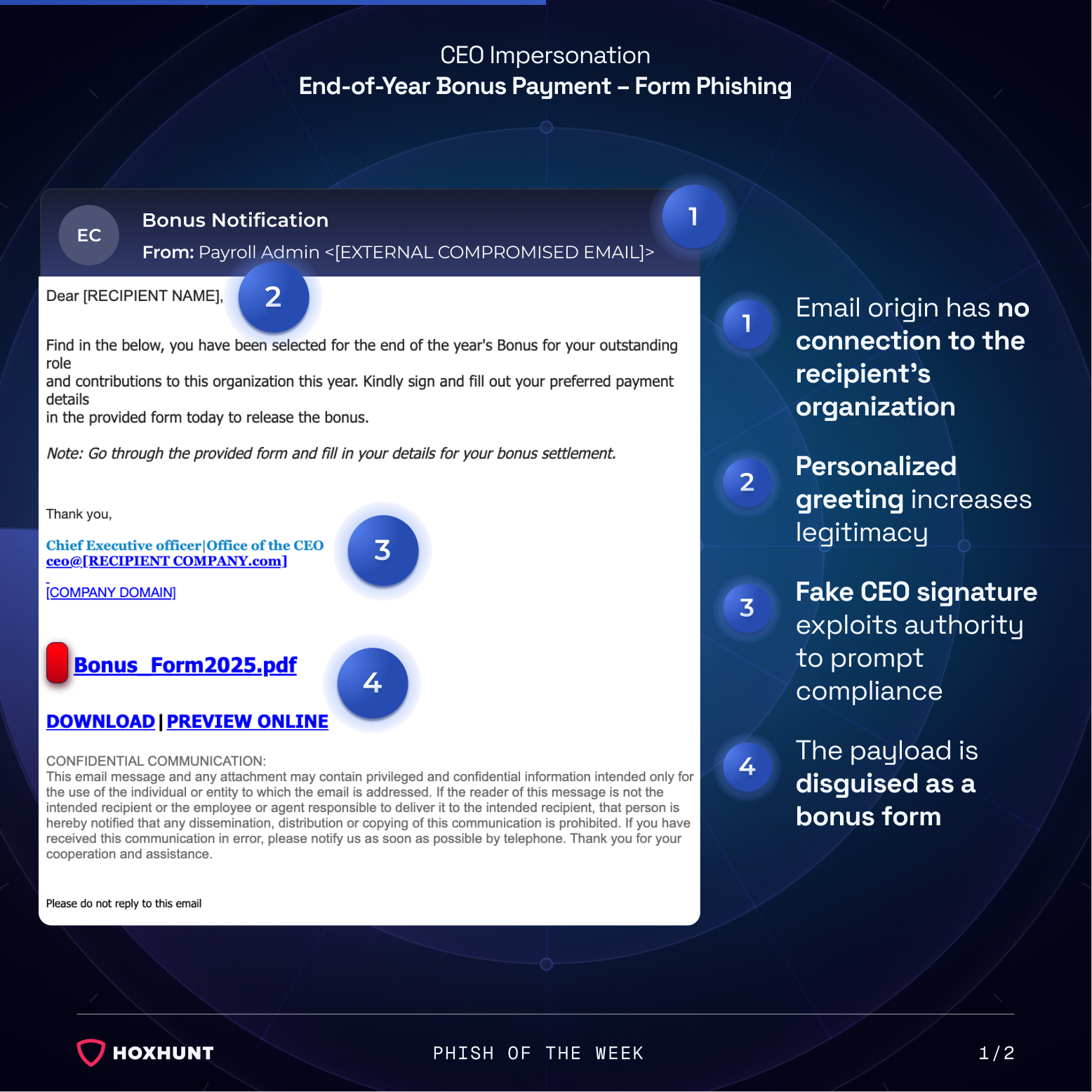
This CEO impersonation campaign poses as an end-of-year bonus notification, sent from a compromised external account and signed as the recipient’s own Chief Executive Officer. It uses the promise of a reward for “outstanding contributions” to get employees to open a fake bonus form and hand over their payment details.
How the attack works:
The recipient receives an email from “Payroll Admin.” The actual address behind the sender display name is a compromised external account with no connection to the recipient’s organization.
The email greets the recipient by name and says they have been selected for the end-of-year bonus. It asks them to sign the provided form and fill in their preferred payment details “today” to release the payment.
The signature block lists a CEO address and website on the recipient’s own company domain. The sender and the signature don’t match: the message comes from payroll but is signed by the CEO.
Below the signature sits what looks like a pdf attachment, but that isn’t a real file. It’s a group of hyperlinks styled to look like a PDF, and every one of them leads to malicious content hosted outside the recipient’s organization.
Why the attack works:
Being told you were picked for a bonus is flattering, and recipients are more likely to look for a reason to believe a reward than to doubt it.
Using the CEO’s name adds pressure to act quickly. Few employees would want to delay or question a request that seems to come from the top of the company, especially when it says the bonus is released only once the form is filled in “today.” The personalized greeting and a signature that uses the company’s own domain are enough to make the message feel internal at a glance, even though the actual sender is an outside account.
How to spot similar attacks:
- The sender’s email address belongs to an external domain, even though the message claims to come from payroll and the CEO.
- The “attachment” is a set of links styled to look like a PDF, instead of a file actually attached to the email.
- The email asks for payment details through a form, which is not how companies normally handle bonus payouts.
- The wording is awkward (“Find in the below”) and the line breaks are uneven, which you wouldn’t expect from an official message from the CEO’s office.
If you receive an unexpected bonus notice, go to your company’s HR or payroll system directly to check whether it’s real, instead of opening links or forms in the email.
What is Phish of the Week?
Phish of the Week is a weekly content initiative by Hoxhunt’s Threat Operations team. Each week, we highlight a current phishing trend or notable real-world attack, covering what the threat is, how it works, and what to watch for to spot similar attacks in the future. The goal is to build consistent recognition of evolving phishing themes and tactics over time.
Comments (0)
Popular

Dive in