

Content Creation
June 23, 2026 · Last updated on July 2, 2026
SECURE - A Content Checklist

# Narrative
# Storytelling
# Content
The Checklist I Run Before I Publish Anything

Ant Davis
We spend a lot of time in this profession worrying about whether people will do the right thing. Click the right link. Report the right email. Follow the right policy. But before any of that, there's a question we don't often ask ourselves.
Is the thing we made actually worth their attention?
Because here's something I think that you may not agree with: most security awareness content doesn't fail because employees don't care. It fails because it isn't relevant, it isn't clear, and it doesn't connect with anyone. We blame the audience for switching off when really we handed them something easy to switch off from.
So I built myself a gate. A simple checklist I run before I write, record, or publish anything that's going out to an audience. It spells SECURE, which feels about right.
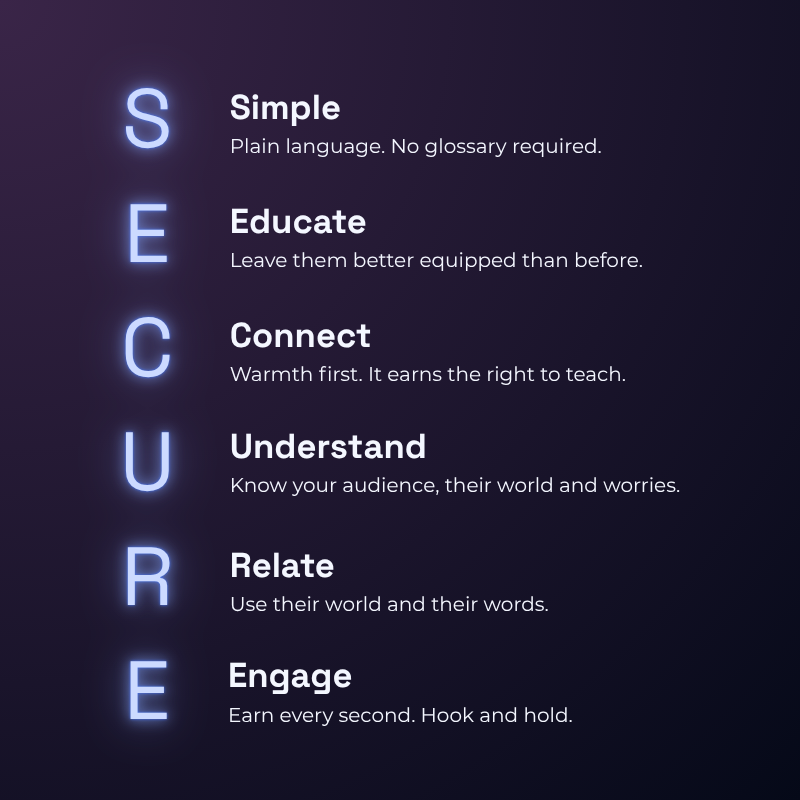
S is for Simple
If someone needs a glossary to get through your first sentence, you've already lost them. Simple isn't dumbing down. It's the hard work of taking something genuinely complicated and making it land in plain language. The best awareness content sounds like a person explaining something to a mate, not a policy document read aloud. I always picture me trying to explain it to my 80 year old mum!
Ask yourself: could someone with zero security background follow this?
E is for Educate
Every piece of content should leave someone slightly better equipped than they were a minute ago. Not lectured. Not scared. Educated. There's a difference between making people feel informed and actually changing what they know or can do. Aim for the second one. If they walk away with one thing they can use, you've earned the time they gave you.
C is for Connect
This is the one most of us skip. Connection is the bridge between your message and the human receiving it. It's tone, warmth, a bit of personality. It's the difference between content that feels like it came from the IT department and content that feels like it came from someone who actually likes people. Connect first, and they'll let you teach them anything.
U is for Understand Your Audience
You cannot create relevant content for people you don't understand. What do they actually do all day? What are they worried about? What's the real moment where security collides with their job and gets in the way? When you understand your audience, everything downstream gets easier, because you're no longer guessing. You're speaking to a real person you can picture.
R is for Relate
Understanding feeds relatability. Once you know your audience, you can hold up a mirror and say, "this is you, this is your Tuesday afternoon, this is the email that's going to land in your inbox." Relatable content meets people where they already are. It uses their world, their language, their scenarios. The moment someone thinks that's me, they're paying attention in a way no statistic will ever achieve.
E is for Engage
Finally, does it actually hold them? Engagement is what keeps someone watching, reading, or listening past the first five seconds. It's the hook, the pacing, the small surprise that stops the scroll. You can tick every other box and still lose people if it's dull. Engaging content respects the fact that you are competing with everything else fighting for their attention, and you have to earn every second.
Running the gate
So that's it. Six checks, one word.
- Is it Simple?
- Does it Educate?
- Does it Connect?
- Do I Understand my audience?
- Does it Relate to them?
- Does it Engage?
Before anything I make goes out, it has to pass through SECURE. If one of those is missing, I know exactly what's wrong before I hit publish, rather than wondering later why nobody engaged.
We ask employees to pause and think before they act. It's only fair we hold ourselves to the same standard before we put content in front of them. Make it S.E.C.U.R.E. first.
Comments (0)
Popular

Dive in